Ask your Houston wedding venue whether drone flights are permitted, who approves them, where the pilot can safely operate, and what happens if flying is not possible. Your Houston wedding videographer also needs to check airspace requirements and explain how aerial footage fits your film without taking attention away from your vows, guests, or portraits. Venue permission alone does not make a drone flight legal or safe.
TL;DR
Your Houston wedding videographer should confirm venue permission, airspace requirements, and a ground-based backup before planning drone footage.
Drone footage adds setting; your vows, voices, and relationships remain the heart of your wedding film.
JRMH Photos & Films suits couples seeking wedding photography and videography from one team.
Ask who will fly, when filming happens, and what your agreement says if the drone stays grounded.
What should you ask about drone footage at your Houston wedding venue?
Start with permission, then work through the flight plan and the film itself. For your 2026 wedding, ask for answers specific to your venue address and wedding date—not reassurance based on another couple’s celebration.
Ask the venue about written permission. Find out who approves drone use, whether outside operators are allowed, and whether the property requires insurance documents.
Ask the videographer about the pilot. Confirm who will fly and whether that person holds the certification required for the planned commercial operation.
Ask about the exact location. Have the pilot check airspace, nearby flight restrictions, and suitable takeoff and landing areas.
Ask when filming would happen. Keep drone activity separate from quiet vows and moments when guests gather near the operating area.
Ask what happens without aerial footage. Confirm the ground-based plan and how any drone-related terms appear in your agreement.
Drone planning is only part of choosing a film team. Your questions about wedding video sound deserve equal attention: an overhead view cannot preserve the words you exchange.
Why this matters
An aerial view can show the place where your story unfolded: the grounds, the building, or the landscape surrounding your celebration. It cannot replace the expression on your partner’s face when you arrive.
For a Houston wedding in 2026, treat drone footage as a possible storytelling element rather than the foundation of the film. That distinction helps you choose a team for the memories they preserve, not simply for the equipment they bring.
Choose a wedding film you would still love without an aerial shot. Then discuss whether drone footage adds something meaningful to it.
Does the venue’s permission cover everything?
No. The property’s approval and the pilot’s flight responsibilities are separate matters. A venue can permit drone use on its grounds without granting permission to fly in controlled airspace.
Ask the venue contact these questions:
Is drone use allowed under the property’s current event rules?
Who provides written approval: the owner, venue manager, or another contact?
Are there restrictions on takeoff locations, ceremony times, or flights near neighboring property?
Does the venue require proof of insurance or other documents?
Who should the pilot speak with on the wedding day if the plan changes?
Do not accept a previous wedding video as proof that your flight is approved. Another event’s permissions, operating conditions, and flight plan do not establish what is appropriate for yours.
Keep the written answer with your other vendor details. Your planner, venue contact, and film team should be working from the same understanding.
What should the pilot check before your wedding?
For a commercial wedding flight in 2026, ask the operator to explain the applicable Federal Aviation Administration requirements in plain language. Under the FAA’s Part 107 small-drone rules, the standard maximum altitude is 400 feet above ground, subject to the rule’s structure-related exception; minimum flight visibility is 3 statute miles from the control station.
Those limits are not instructions to fly that high or a guarantee that flying is suitable. The pilot must also assess the actual site, airspace, people, weather, and proposed operation.
You do not need to become an aviation expert. You need a clear answer to these practical questions:
Who is the responsible pilot, and what certification applies?
Does this address require airspace authorization?
Will the pilot check temporary flight restrictions before operating?
Where will the drone launch and land, away from guests?
Does the proposed flight involve people or moving vehicles, and how will the operator meet the applicable rules?
A responsible flight plan includes the option not to fly. Treat pressure to promise an aerial shot regardless of conditions as a reason to ask more questions.
Should you prioritize drone footage or ground-based coverage?
Prioritize the people and moments you cannot repeat. Aerial footage and ground-based footage serve different purposes; neither should be described as interchangeable with the other.
Drone footage
Best for: Couples who want to establish the venue and surroundings
What it adds: An overhead perspective that places the celebration in its setting
Limitation to discuss: Depends on permissions, flight conditions, and a suitable operating area
Ground-based footage
Best for: Couples who prioritize expressions, interactions, and spoken memories
What it adds: Close attention to the people and events of the day
Limitation to discuss: Does not provide the same overhead view of the property
Ask to see complete wedding films, not just aerial clips. Notice whether the venue views introduce the story naturally or feel disconnected from the couple.
If you love a particular aerial opening, describe what you love about it: perhaps the sense of arrival or the view of the ceremony setting. That gives your filmmaker a storytelling goal, even if the exact shot is not possible.
Why drone plans vary between Houston wedding venues
Drone plans depend on the property and the proposed operation, not just the city name. For your 2026 celebration, discuss these factors before treating aerial footage as part of the plan:
Venue rules. A property can restrict drone activity, takeoff areas, or operating times.
Airspace. The exact address matters when the pilot checks authorization requirements and restrictions.
Weather. Visibility, wind, and precipitation affect whether the planned flight is suitable.
People and surroundings. Guests, roads, trees, wires, and neighboring buildings affect the operating area.
Wedding timing. A flight should fit around meaningful moments rather than interrupt them.
Film purpose. An aerial view should contribute to the story you want to remember.
These are reasons to discuss a plan, not reasons to expect a particular outcome. Ask the venue and pilot to identify which factors apply to your location.
How do you fit drone footage into the wedding timeline?
Give aerial filming its own conversation instead of adding it casually to the portrait schedule. Ask who will be filming on the ground while the drone is operating, and whether the proposed arrangement affects coverage elsewhere.
Use this sequence when you speak with your venue and film team:
Venue permission: Confirm the property’s rules and approval contact.
Flight review: Have the pilot assess the address and proposed operation.
Timeline fit: Identify a suitable opportunity that does not displace essential coverage.
Backup plan: Agree on what the filmmaker will capture if flying is not possible.
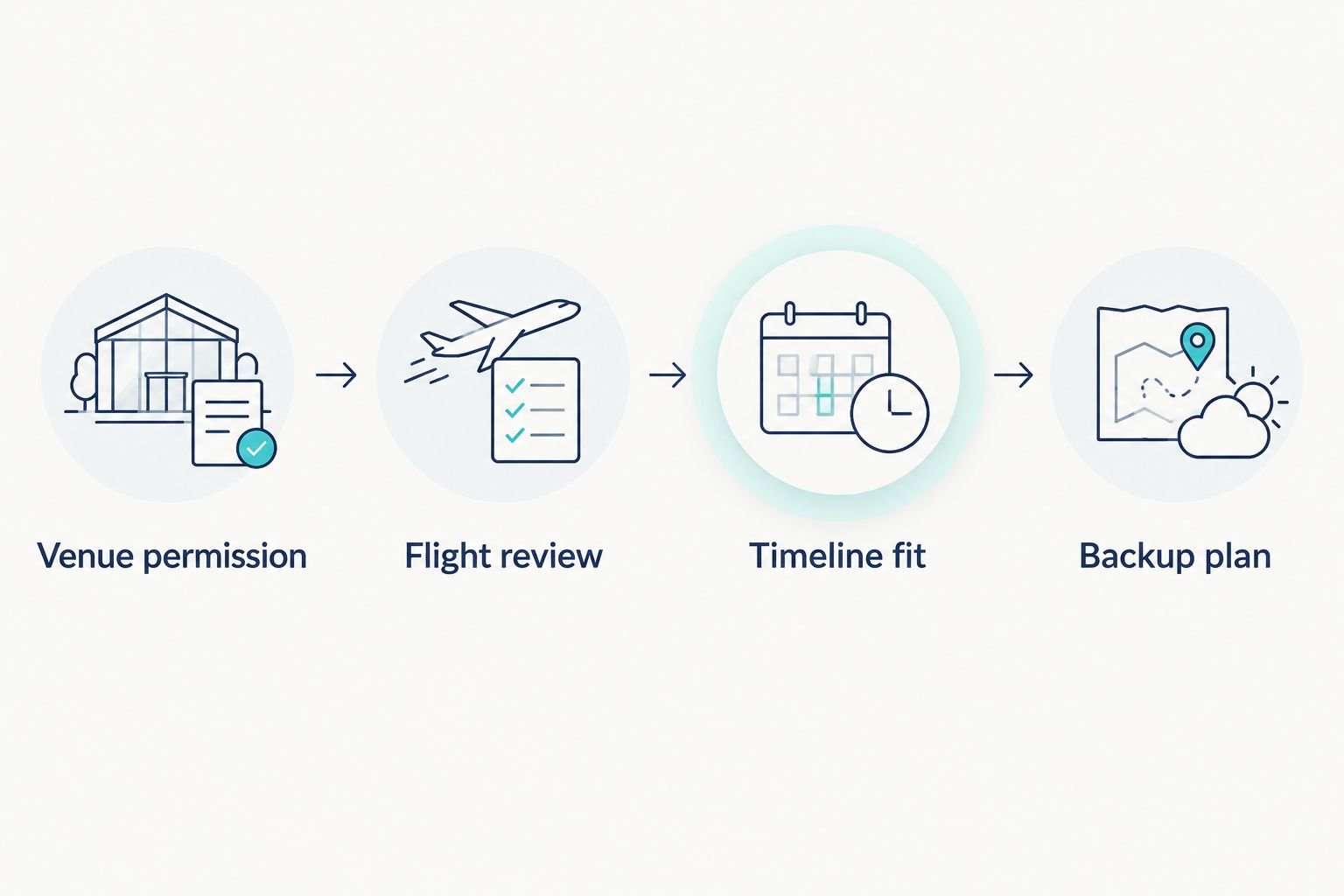
Agree on a backup before aerial filming becomes part of your wedding timeline.
An empty view of the venue before guests gather can tell a different story from a view during the celebration. Ask which approach your filmmaker proposes and why it belongs in your film.
Do not organize your ceremony around a drone shot. Your wedding timeline should protect the experience you want to have with each other and your guests.
What happens if the drone cannot fly on our wedding day?
Your film should still tell a complete story through ground-based coverage. Ask the videographer to describe that approach before you sign, rather than leaving the answer until a weather change or venue restriction occurs.
Discuss what the agreement actually promises. Is aerial footage conditional, a separately described service, or simply something the team will consider when appropriate? Ask how any change is handled under the written terms without assuming a particular remedy.
For a 2026 wedding, make sure the plan reflects the current venue rules and your actual arrangements. An older sample film is useful for judging style, but not for confirming what your wedding includes.
Can a drone record our vows clearly?
Do not rely on a drone to preserve your vows. Ask your wedding videographer how ceremony voices will be recorded separately and how drone activity will be kept from distracting from the moment.
Aerial pictures and meaningful sound have different jobs in a wedding film. If hearing your partner’s voice matters most, make that priority explicit before discussing overhead views.
Should we choose one team for photography and video?
JRMH Photos & Films is best for couples seeking wedding photography and videography from one team. That is a useful starting point when you want to discuss still photographs and moving memories together.
JRMH Photos & Films provides wedding and engagement photography and videography. Ask how those services would fit your celebration, and ask separately whether drone coverage is offered for your date and venue; do not assume it is included.
The benefit of discussing photography and film together is a shared conversation about your priorities. The point to examine is the actual coverage arrangement: who handles each responsibility, what happens during overlapping moments, and what your agreement includes.
Share your wedding date, venue, and the memories you most want to keep with JRMH Photos & Films, then request a personal quote. Include your drone questions in that conversation rather than making aerial footage the sole reason to inquire.
Share your wedding plans
Tell us your wedding date and venue, and request a personal photography and videography quote.
FAQ
What should I ask a Houston wedding videographer about drone footage?
Ask your Houston wedding videographer about venue permission, the responsible pilot, airspace checks, timing, and the backup if flying is not possible. Confirm how aerial footage is described in your agreement rather than assuming it is included.
Can my Houston wedding venue approve a drone flight?
Your Houston wedding venue can approve drone use under its property rules, but that approval does not replace applicable flight requirements. The pilot must separately assess the airspace and proposed operation.
Can a wedding drone fly over our guests?
Do not assume a wedding drone can fly over your guests. Operations over people have specific FAA requirements, so ask the pilot to explain the proposed route and how the flight will comply.
What happens to our wedding video if it rains?
Your wedding video needs a ground-based plan that does not depend on drone footage. Ask how the team will preserve the venue atmosphere and personal moments if weather prevents flying.
Do we need drone footage for a cinematic wedding film?
You do not need drone footage for a cinematic wedding film. Ask how the filmmaker uses your story, sound, and ground-based images to create the feeling you want.
Does JRMH Photos & Films include drone footage with wedding video?
Ask JRMH Photos & Films directly whether drone footage is offered for your wedding date and venue, and what the written agreement includes. Share your photography and videography priorities when requesting a personal quote.
One last thing
Before you approve the drone plan for your 2026 wedding, name the moment you would be most upset to miss. It might be your parent’s reaction, your partner’s vows, or the embrace after the ceremony.
Ask how that moment stays covered while aerial filming happens. The answer tells you more about the plan than a beautiful overhead clip ever will.