Your wedding photographer and videographer should be one team if you love both their photographs and films, and they clearly explain how they will share responsibility for your day. Separate providers are a good choice when you prefer different artists and both agree to coordinate before the wedding. Choose the people and their work first; choose the booking arrangement second.
TL;DR
Choose a wedding photographer and videographer together only when you love both portfolios and understand each person's role.
Separate wedding photography and videography providers suit couples who prefer different artists and confirm how they will coordinate.
JRMH Photos & Films is best for couples seeking wedding photography and videography from one provider.
Ask who will attend, what you will receive, and who handles questions before signing.
Should your wedding photographer and videographer be one team?
Yes, when the shared team offers the photography and film style you want, with clear responsibilities in writing. One booking is not proof that the people covering your wedding work well together. Ask how they plan the ceremony, portraits, and reception, and who you will speak with when something changes.
For Houston couples choosing coverage in 2026, the useful comparison is not simply one company versus two. It is whether the proposed arrangement preserves the moments you care about without leaving you to settle competing requests on your wedding day.
Start with how to choose a Houston wedding photographer and videographer, then compare the arrangements below.
One photography and videography team
Best for: Couples who love both kinds of work from the same provider
What supports the choice: A shared planning conversation can bring your priorities together
What to watch for: A strong photography portfolio does not establish the quality of the films; confirm both
Separate photography and videography providers
Best for: Couples drawn to different artists for photographs and film
What supports the choice: You can choose each provider for the work you specifically love
What to watch for: You need an agreed way for both providers to coordinate timing, positioning, and requests
Neither arrangement removes the need to read your agreement. The name on the booking matters less than knowing who will be there and what each person is responsible for.
Why this matters
Your photographs let you return to an expression, an embrace, or a detail you barely noticed. Film can preserve movement and spoken moments when those are part of the agreed coverage. You are choosing different ways to remember the same day.
That is why the decision deserves more than a combined-package label. A beautiful gallery cannot tell you whether you will enjoy the film's pacing, and a moving film cannot show you how a photographer handles family portraits.
For your 2026 wedding, judge photography and videography separately before deciding whether to book them together. You should feel comfortable with both, not accept one as an afterthought.
One team: best for a shared planning conversation
A combined provider suits you when you want to discuss your memories, priorities, and wedding-day plans in one place. That can be especially appealing if you want photographs and film to tell the same personal story: the quiet anticipation, the ceremony, and the people gathered around you.
The benefit depends on the actual arrangement. Ask whether there is a shared plan, who leads communication, and how the photography and videography roles are divided. Do not assume that one company means one contact or the same people at every wedding.
The trade-off is choice. You might love a provider's photographs but feel less connected to the films, or the reverse. Booking together should not mean overlooking that difference.
Choose one team when both portfolios feel right and the working arrangement is clear. If either part leaves you unsure, keep comparing before you commit.
Separate providers: best for choosing each artist independently
Separate providers suit you when a particular photographer and a particular videographer each create work you love. You do not need matching business names to preserve the same wedding with care.
The benefit is that you can assess each artist independently. You can choose the photographs for their treatment of people and moments, then choose the films for their storytelling and feeling.
The trade-off is the coordination you need to confirm. Each provider should understand the other's role, the ceremony plan, and any time reserved for portraits. Ask who will bring those details together rather than assuming someone else will handle them.
Choose separate providers when the artistic fit is stronger and both agree to a shared plan. Do not book on the expectation that they will work out every detail after arriving.
Why the right team arrangement varies
The best choice depends on what you want to remember and how the proposed providers will work. Use these factors to make the decision personal rather than treating one arrangement as automatically better.
Your connection to both portfolios. You should enjoy the photographs and the films independently. A combined offer does not make an unwanted style a better fit.
Your ceremony priorities. Tell providers whether vows, readings, family reactions, or particular traditions matter most, then ask how they would approach them.
Your portrait plans. If you want both still portraits and filmed moments, ask how those requests fit together without competing for the same part of the day.
Your communication preference. Decide whether you want a shared contact or are comfortable communicating with separate providers. Confirm what is actually offered.
Your written scope. The agreed coverage, deliverables, responsibilities, and terms should guide the decision, not the package name alone.
A provider does not need to give the answer you expected to give a useful answer. A clear explanation of a limitation is more helpful than a promise that everything will be handled without detail.
How do you check whether the team will work well together?
Ask for a practical explanation of your day, not a general assurance about teamwork. Give the provider a moment that matters to you and listen to how they divide responsibility.
Review both portfolios
Look at full wedding galleries as well as complete examples of the films being discussed. Highlight images and short clips can introduce a style, but they do not answer all your questions about the finished work.
Notice whether you connect with the quieter moments, not just the dramatic ones. Can you imagine enjoying the family photographs and the ceremony storytelling as much as the couple portraits?
Discuss shared moments
Ask how photography and videography will approach the ceremony, family portraits, and any planned speeches. You are not asking for a technical lesson; you are asking how your priorities will be protected.
For example, tell the providers if seeing your partner's reaction matters deeply to you. Ask how that request will be included in the plan, without assuming a particular photograph or recording is guaranteed.
Confirm responsibilities
Find out who is scheduled to attend and what each person's role will be. Ask whether the people whose work you reviewed are the people expected to cover your wedding, and how any changes are handled.
Also confirm who answers planning questions. With separate providers, ask whether they will communicate directly before the wedding and what information they need from you.
Read the agreement
Compare the conversation with the written terms. If something is essential to your decision, ask for it to be clarified before signing rather than relying on your memory of a call.
Your agreement should make the proposed scope understandable. Use what wedding photo and video packages should include to prepare questions, not to assume every provider includes the same things.
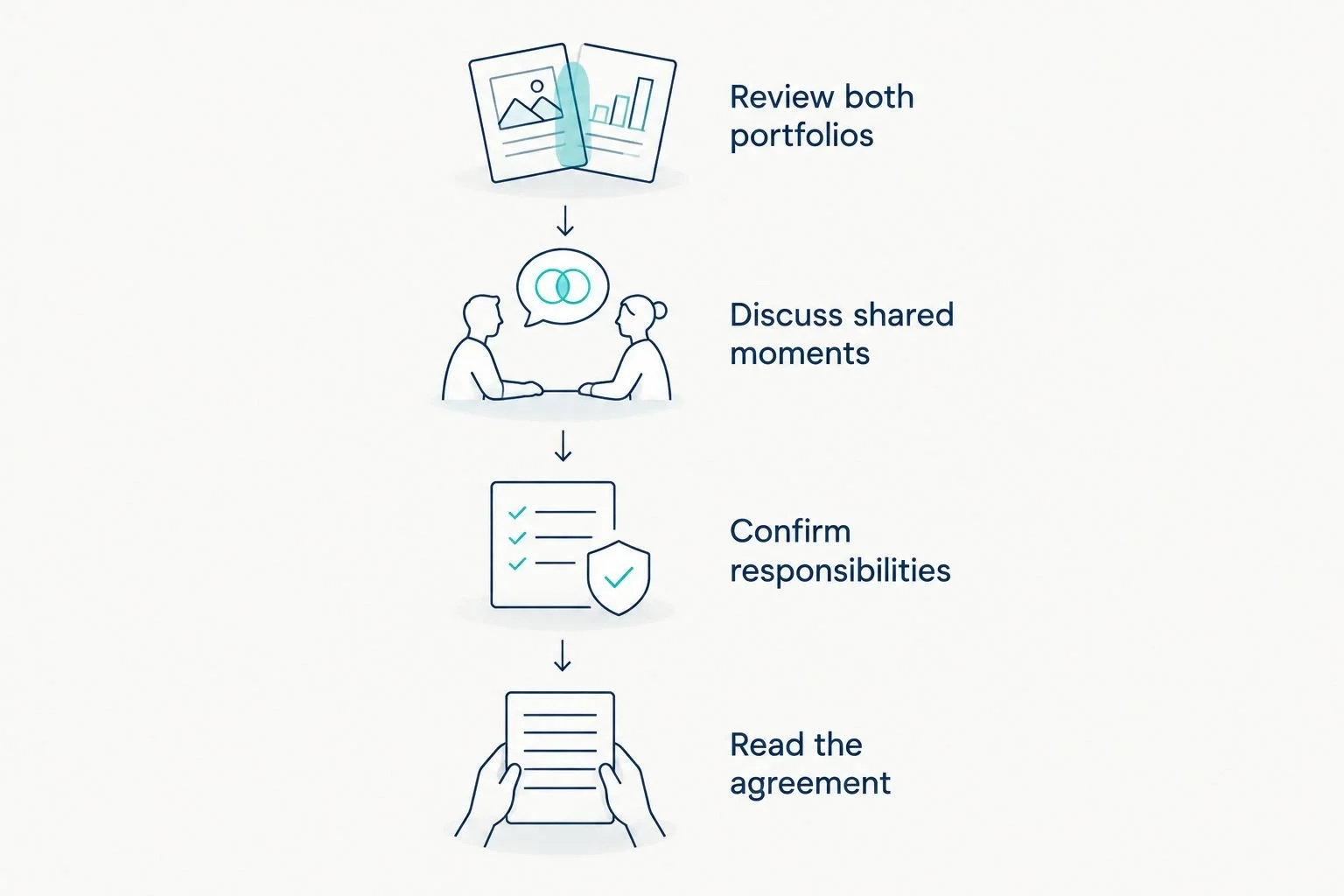
Review the work first, then confirm how the people and agreement support your priorities.
What should Houston couples ask before booking in 2026?
Bring questions that connect the provider's work to your own wedding. You do not need to know photography or film terminology to explain which memories matter.
Who is expected to photograph and film our wedding?
Can we review full galleries and complete examples of the films you are proposing?
How will photography and videography share portrait time?
How do you plan positioning during the ceremony?
Who should we contact about changes to our plans?
What photographs and films are included in the written proposal?
How are changes in the assigned people handled?
What delivery terms will appear in our agreement?
Listen for specific answers, not just reassuring language. A useful answer connects the question to a person, a responsibility, or a written term.
If you are considering engagement photography too, bring it into the same conversation. Ask whether it is offered within the proposed arrangement or discussed separately; do not treat it as an automatic inclusion.
How should you compare combined proposals in 2026?
Compare proposals against the same priorities. If one describes wedding photography in detail but barely explains the film, ask for clarification before treating the proposals as equivalent.
Write down the ceremony moments, portrait preferences, and reception memories that matter to you. Then check how each proposal addresses them and which requests still need a conversation.
Separate what is promised from what is simply possible. A provider offering videography does not establish which film formats, recorded moments, or delivery terms are included in your booking.
The same applies to cinematic wedding films. Ask to see complete examples and explain what you enjoy about them: the emotion, spoken moments, pace, or way the story unfolds. Then confirm which kind of film the proposal actually covers.
Choose the clearest fit for your memories, not the proposal with the most appealing label. An unanswered question should stay visible until the provider answers it.
Can one team capture photography and video at the same time?
One provider can offer both services, but you still need to ask who will perform each role. A combined booking does not tell you whether separate people are assigned to photography and videography.
Ask how simultaneous moments are approached, especially during the ceremony. The useful answer explains the proposed responsibilities and limitations without promising that every angle or reaction will be captured.
Should your wedding photos and film have the same style?
Your wedding photos and film should both feel like memories you want to revisit; they do not need to look identical. Photography and film tell the story differently.
Compare how each treats emotion, color, portraits, and the people around you. If you love the photographs but not the films, a shared provider alone is not a reason to book both.
What should you send when requesting a personal quote?
Share your wedding date, Houston-area venue or planned location, and whether you want photography, videography, engagement photography, or a combination. Add the moments that matter most and any plans already taking shape.
JRMH Photos & Films provides wedding and engagement photography and videography. JRMH Photos & Films is best for couples seeking wedding photography and videography from one provider. The next step is to review both kinds of work and request a personal quote, rather than assume particular package features.
Share your wedding plans
Share your wedding date and the photography and videography you want, then request a personal quote.
FAQ
Is it better to book a wedding photographer and videographer together?
Booking a wedding photographer and videographer together is a good choice when you love both portfolios and understand the shared working arrangement. Separate providers are a good choice when each artist is a stronger fit and both agree to coordinate.
Does one wedding photography and videography company mean one person will do both?
One company does not establish who will perform each role. Ask who is expected to attend, what each person will do, and how the proposed coverage handles simultaneous moments.
Should I review full wedding galleries before booking photo and video?
Yes, review full wedding galleries and complete examples of the proposed films before booking. Assess each kind of work separately so that a strong photography portfolio does not stand in for reviewing videography.
Does a combined wedding package automatically include engagement photography?
A combined wedding package does not establish whether engagement photography is included. Ask the provider and confirm the answer in the written proposal.
What should Houston couples confirm before booking in 2026?
Houston couples booking in 2026 should confirm the assigned roles, coverage, deliverables, communication arrangements, and written terms. Explain your ceremony and portrait priorities so the provider can address your actual plans.
How do I ask JRMH Photos & Films for a personal quote?
Share your wedding date, planned location, and the wedding or engagement photography and videography you want. Explain the moments you most want to preserve and request a personal quote.
One last thing
Before choosing your 2026 wedding coverage, name a quiet moment you hope to remember—not just a portrait or a grand entrance. It might be your partner listening to your vows or a parent holding your hand before the ceremony.
Bring that moment to your conversation with JRMH Photos & Films or another provider. The right choice begins with feeling understood, then confirming how that understanding appears in the plan.